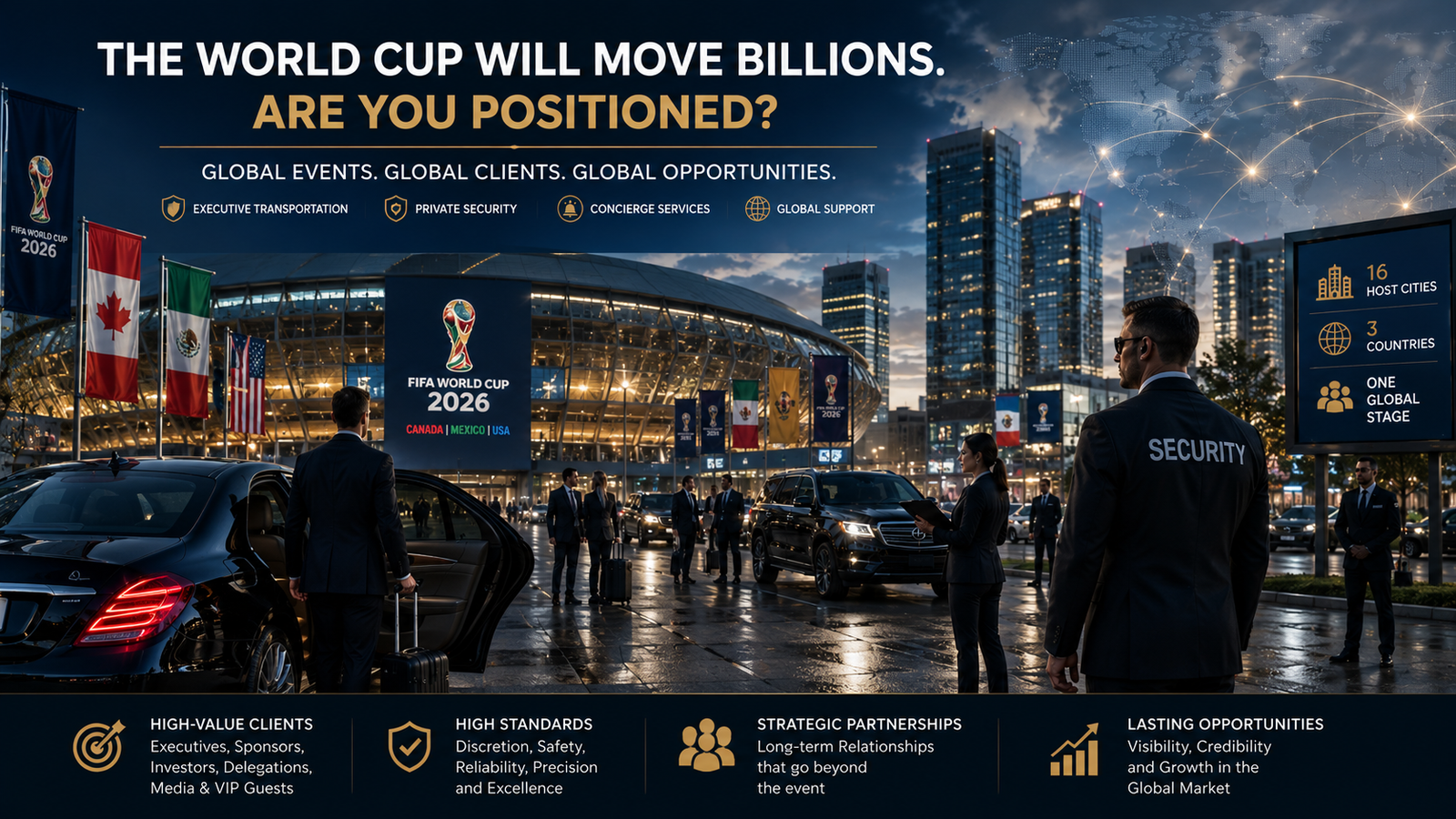


Major global events are often perceived as moments of visibility — peaks of activity where cities, industries, and organizations converge under global attention.
Yet for companies operating in premium service sectors, the true opportunity does not lie in the event itself.
It lies in the window that opens before and around it.
This window is rarely visible. It does not appear in public announcements or marketing channels. Instead, it exists within planning cycles, closed networks, and early-stage decision-making processes.
In industries such as executive transportation, private security, concierge services, and corporate support, companies that capture these opportunities are not reacting to the event.
They are already positioned when the window opens.
Understanding this strategic window reveals why some organizations consistently access high-value global opportunities — while others remain outside the field of consideration.
The Nature of the Strategic Window
Global events are not isolated occurrences.
They are the culmination of long planning cycles involving governments, corporations, logistics providers, and operational partners. Months — often years — before the event becomes visible to the public, decisions are already being made.
During this period, a strategic window emerges.
Within this window:
- service providers are identified
- partnerships are formed
- operational frameworks are defined
- trusted networks are activated.
This is when the real allocation of opportunity occurs.
By the time the event reaches public visibility, much of the ecosystem is already structured.
For companies operating in high-trust services, this means that access is not determined during the event.
It is determined before the market becomes aware that an opportunity exists.
This shifts the focus from reaction to positioning.
How Companies Actually Compete for These Opportunities
In theory, major global events create demand across multiple service categories.
In practice, however, access to that demand is highly selective.
Organizations responsible for delivering large-scale events operate under significant pressure. They must ensure:
- operational continuity
- security and risk management
- seamless coordination across stakeholders
- reliability under unpredictable conditions.
Because of this, decision-makers prioritize certainty over discovery.
Rather than exploring unknown providers, they rely on:
- existing partnerships
- trusted networks
- previously validated companies
- recommendations within professional ecosystems.
This approach minimizes risk.
It also limits access.
Companies that are not already positioned within these networks often do not have the opportunity to compete.
Their absence is not due to lack of capability.
It is due to lack of strategic presence at the moment decisions are made.
Why Most Companies Miss the Strategic Window
Many organizations approach global events with a reactive mindset.
They monitor announcements, track event calendars, and prepare operational capacity in anticipation of increased demand.
While these actions are logical, they occur too late in the process.
By the time demand becomes visible, the strategic window has often closed.
Several factors contribute to this disconnect.
First, companies tend to focus on visible opportunity rather than hidden decision cycles.
They expect opportunities to be accessible through:
- tenders
- public partnerships
- inbound requests.
In high-trust environments, however, many decisions occur privately and early.
Second, organizations often underestimate the role of perception.
They assume that being operationally ready is sufficient.
In reality, decision-makers prioritize companies that already appear credible within their network.
Third, positioning is frequently treated as secondary.
Without clear positioning, companies may operate internationally yet remain unrecognized within the contexts where opportunities are formed.
The result is a recurring pattern:
- the opportunity exists
- the company is capable
- but the company is not present when decisions are made.
Three Strategic Signals That Align Companies with the Window
Companies that consistently access global event ecosystems tend to demonstrate a set of strategic signals that align them with the timing and structure of these opportunities.
1. Early Ecosystem Integration
Organizations that are part of global service networks gain early visibility into upcoming activity.
They are connected to:
- corporate travel infrastructures
- security coordination networks
- international logistics ecosystems
- cross-border service alliances.
These connections place them closer to the decision-making process.
When the strategic window opens, they are already within the field of consideration.
2. Recognizable Global Positioning
Companies that are clearly positioned within the global market are easier to identify and evaluate.
They communicate:
- their role within international operations
- their experience in complex environments
- their relevance beyond local markets.
This clarity allows decision-makers to quickly understand where the company fits.
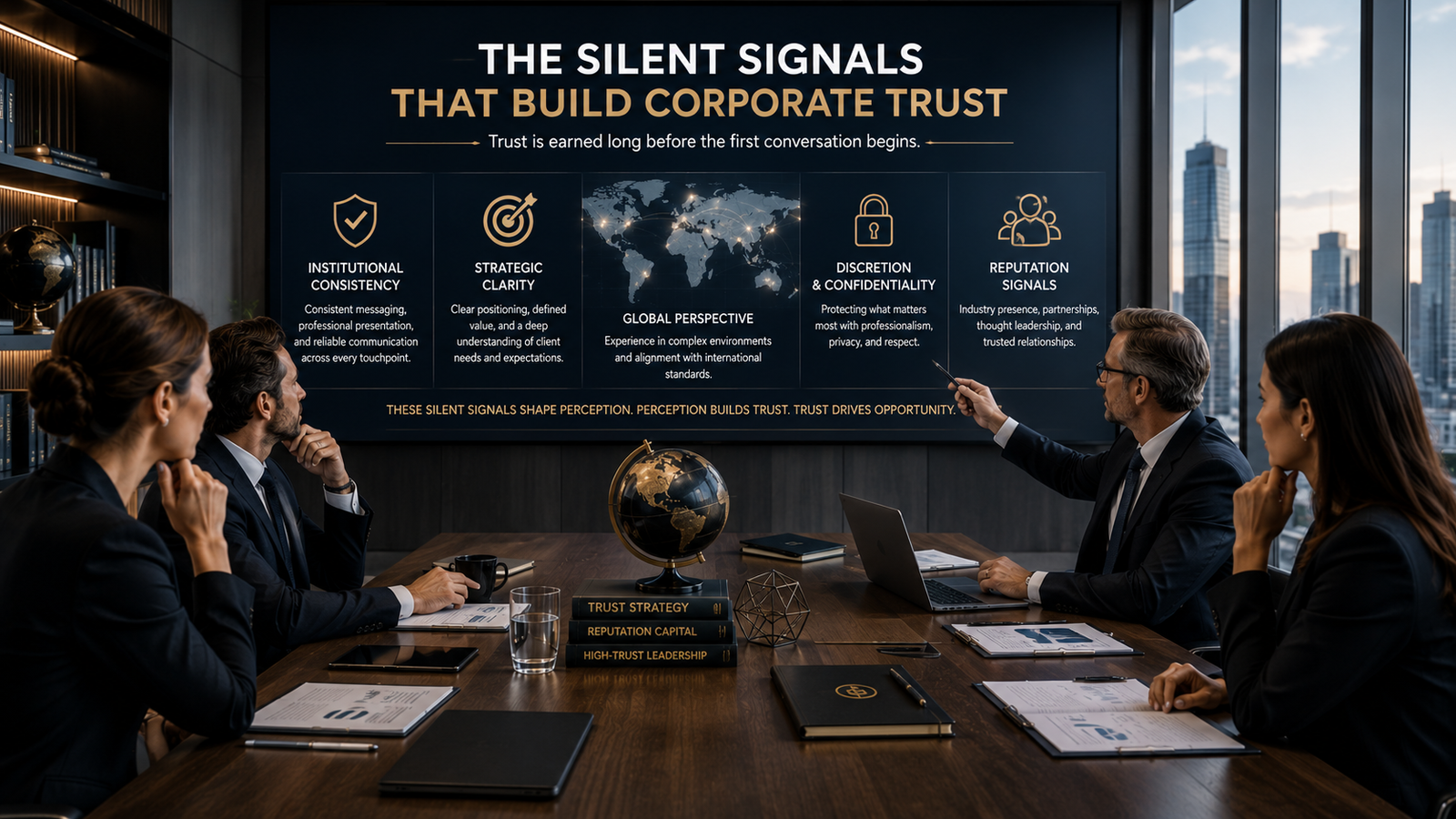
In high-pressure environments, clarity accelerates trust.
3. Proven Reliability in Complex Environments
Global events amplify operational risk.
As a result, companies with demonstrated reliability in high-stakes situations are often preferred.
This reputation is built through:
- consistent performance across markets
- experience supporting multinational clients
- visible participation in complex operations.
Over time, this creates a form of predictive trust.
Decision-makers rely on past signals to anticipate future performance.
Conclusion
Major global events create significant economic activity, but the most valuable opportunities are rarely visible.
They emerge within a strategic window defined by early planning, trusted networks, and pre-established credibility.
Companies that succeed in accessing these opportunities understand that timing alone is not enough.
Positioning determines presence.
In high-trust service industries, the ability to operate is only part of the equation.
The ability to be recognized — at the right moment, within the right context — is what ultimately determines access.
Organizations that align their positioning with these strategic windows do not wait for opportunity to appear.
They are already in place when it does.
Companies operating in high-trust international markets often discover that growth depends on positioning as much as operations.
If your company is navigating this challenge, applying for a strategic diagnosis can be a valuable first step.