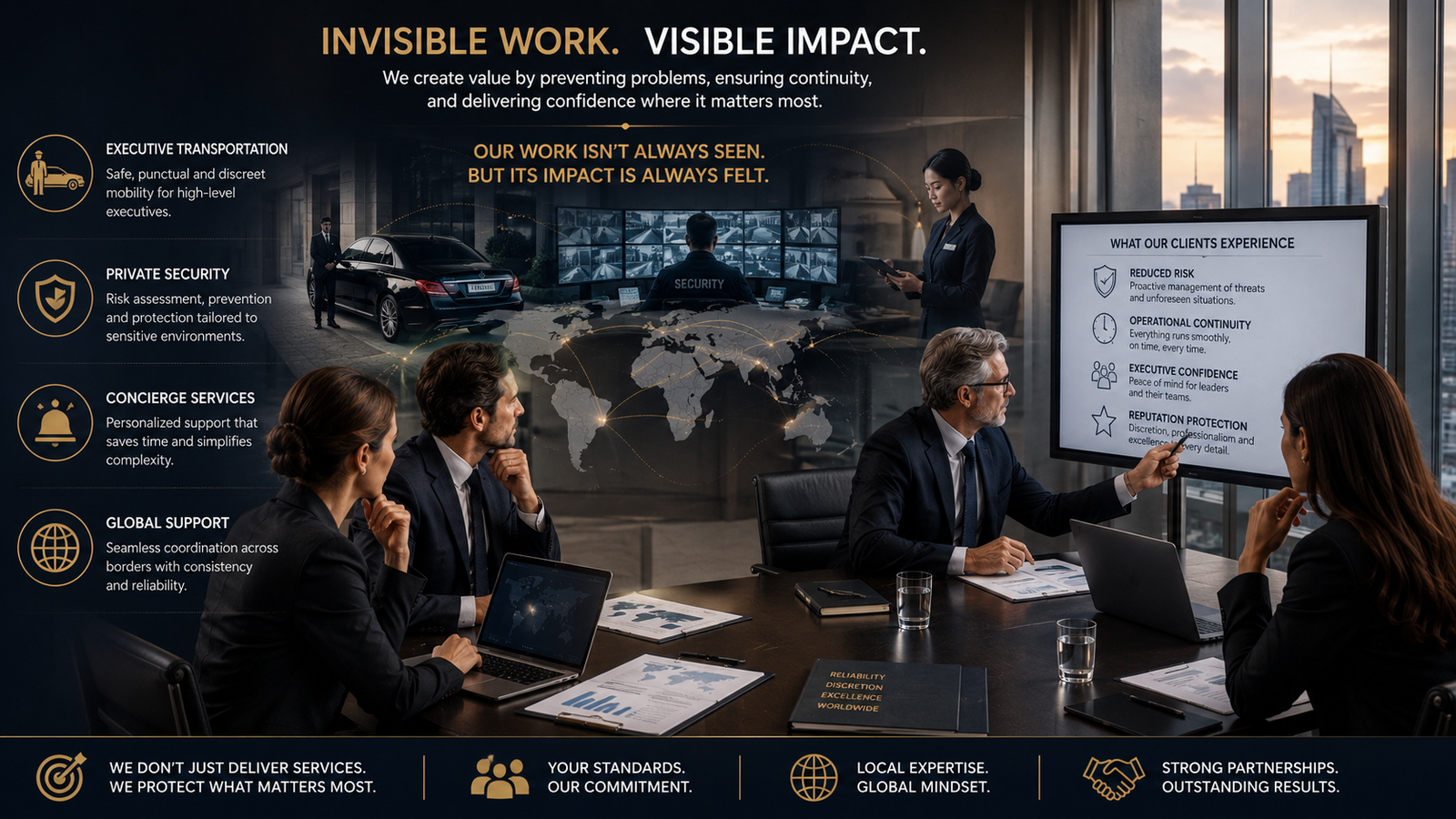


In premium service industries, global presence is often misunderstood.
Many companies assume that operating in multiple countries, building partnerships, or expanding infrastructure naturally leads to international recognition. Yet, across sectors such as executive transportation, private security, concierge services, and corporate support, a different reality emerges.
Some companies operate globally but remain perceived as local providers.
Others, with fewer physical assets, are consistently recognized as global players.
This difference is not operational.
It is perceptual.
Global positioning is not defined by where a company operates, but by how it is understood within international decision-making environments.
Understanding how premium service companies position themselves globally reveals a critical distinction: global presence is built through credibility, clarity, and strategic visibility — not just expansion.
Global Positioning as a Perception Framework
Global positioning is often mistaken for geographic reach.
However, in high-trust B2B markets, positioning functions as a perception framework.
Corporate clients evaluating service providers across borders are not simply mapping coverage areas.
They are assessing:
- whether the company understands international expectations
- whether it can operate consistently across jurisdictions
- whether it aligns with corporate standards
- whether it appears stable and predictable.
These evaluations happen quickly.
Decision-makers rarely have the time or context to deeply analyze every provider.
Instead, they rely on signals that help them interpret the company’s role within the global ecosystem.
A company that communicates clearly as an international operator is perceived differently from one that presents itself as a strong local provider with extended reach.
This distinction determines:
- who enters the conversation
- who is shortlisted
- who is trusted.
Global positioning, therefore, is not a reflection of operations.
It is a structured perception built through consistent signals.
How Corporate Clients Evaluate Global Service Providers
In premium service sectors, corporate clients approach international provider selection with a strong focus on risk management.
Whether selecting a transportation partner for executive travel, a security firm for sensitive operations, or a concierge provider for high-value clients, the decision involves multiple stakeholders.
These typically include:
- procurement teams
- executive assistants and chief-of-staff offices
- security and compliance departments
- operations managers.
Each stakeholder evaluates the provider through different criteria, but they share a common objective: minimizing uncertainty.
Because of this, global providers are assessed based on signals such as:
- consistency across markets
- institutional maturity
- clarity of positioning
- visible experience in international environments
- presence within global service networks.
Importantly, these signals are often evaluated before any direct interaction.
A company that appears globally aligned enters the process with an advantage.
One that appears fragmented or locally anchored may face additional scrutiny.
This dynamic reinforces a key insight: global positioning influences not only perception, but also access to opportunity.
Why Many Companies Struggle to Position Globally
Despite operating internationally, many companies fail to achieve global recognition.
The challenge is rarely capability.
It is alignment between operations and perception.
Several factors contribute to this gap.
First, companies often communicate through a local lens.
They emphasize their leadership within a specific city or country, assuming that this credibility will translate globally.
In practice, international clients lack the context to interpret local leadership.
Second, communication is frequently inconsistent.
Different regions, teams, or partners may describe the company in different ways, creating a fragmented identity.
This fragmentation weakens perception.
Third, many organizations focus on operational expansion without developing a corresponding positioning strategy.
They grow physically, but not perceptually.
As a result, they remain operationally global but strategically local.
This disconnect limits their ability to compete for high-value international opportunities.
Three Strategic Signals of Global Positioning
Companies that successfully position themselves globally tend to demonstrate a consistent set of signals.
These signals shape perception before any formal engagement occurs.
1. A Global Narrative, Not a Local Description
Global companies define themselves through their role in international operations.
They do not rely on local credentials as their primary identity.
Instead of saying:
- “a leading provider in [city/country]”
They communicate:
- their function within global corporate environments
- their ability to operate across jurisdictions
- their alignment with international standards.
This narrative allows decision-makers to immediately understand the company’s relevance.
2. Consistency Across All Markets
Global positioning requires coherence.
Companies that appear consistent across:
- website
- presentations
- proposals
- partnerships
- communication channels
create a unified perception.
This consistency signals control, structure, and reliability.
In contrast, inconsistent messaging creates uncertainty.
And uncertainty increases perceived risk.
3. Visibility Within the Global Ecosystem
Global companies are visible where it matters.
They appear within:
- international service networks
- industry conversations
- professional ecosystems
- cross-border collaborations.
This visibility creates familiarity.
Over time, familiarity becomes trust.
Companies that are repeatedly encountered in relevant contexts are easier to recognize and evaluate.
And recognition accelerates decision-making.
Conclusion
Global positioning in premium service industries is not defined by geography.
It is defined by perception.
Companies that succeed internationally understand that operational capability must be matched by strategic clarity.
They align how they operate with how they are perceived.
They communicate their role within global systems, maintain consistency across markets, and ensure visibility within relevant ecosystems.
In high-trust B2B environments, where decisions are shaped by credibility and risk evaluation, this alignment becomes essential.
Global presence may open the door.
But global positioning determines whether the company is invited in.
Companies operating in high-trust international markets often discover that growth depends on positioning as much as operations.
If your company is navigating this challenge, applying for a strategic diagnosis can be a valuable first step.