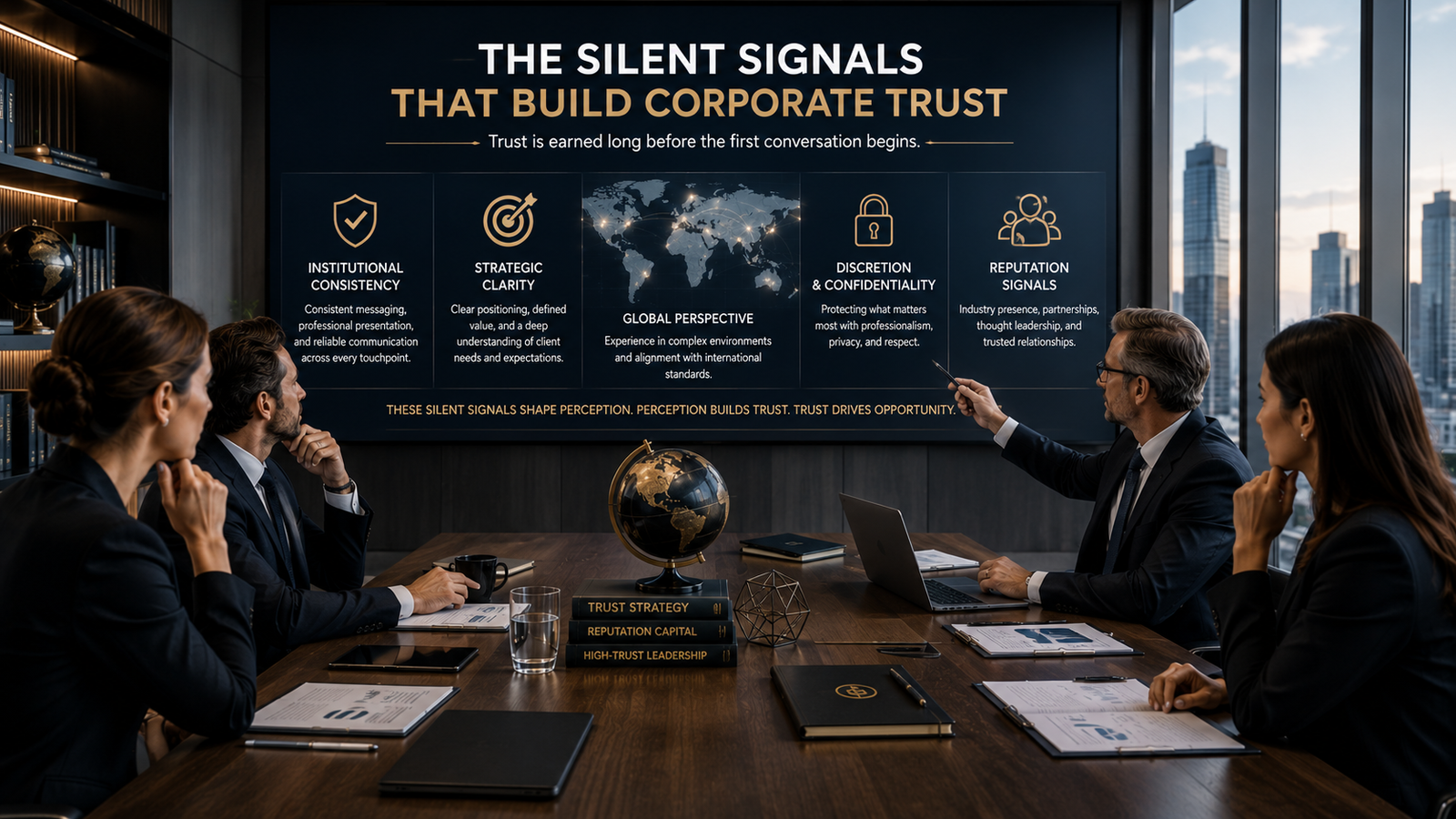


Premium B2B markets rarely operate according to explicit rules.
There are no visible playbooks that explain why certain companies are consistently selected while others, often equally capable, remain outside the decision-making process.
Yet patterns exist.
Across industries such as executive transportation, private security, concierge services, and global corporate support, companies that succeed internationally tend to align with a set of unspoken expectations.
These expectations are not documented, but they are consistently applied by corporate clients.
They shape how companies are perceived, evaluated, and ultimately chosen.
Understanding these silent rules is not about learning tactics.
It is about recognizing the deeper structure of how trust, credibility, and authority function in high-value service environments.
The Nature of Silent Rules in High-Trust Markets
Premium B2B markets are defined by risk sensitivity.
When companies select partners for executive mobility, security operations, or international support services, they are not making transactional decisions.
They are making decisions that affect:
- executive safety
- corporate reputation
- operational continuity
- stakeholder confidence.
Because of this, decision-making processes become more conservative and more structured.
However, instead of relying solely on formal criteria, these markets operate through implicit frameworks.
These frameworks are built on accumulated experience, professional norms, and shared expectations across industries.
They are “silent” because they are rarely articulated.
But they are highly influential.
Companies that align with these expectations appear credible and predictable.
Companies that do not may be perceived as uncertain — regardless of their actual capabilities.
How Corporate Clients Apply These Rules
Corporate clients in premium service sectors do not evaluate providers from a neutral starting point.
They begin with assumptions shaped by experience.
Procurement teams, executive offices, and security leaders rely on mental models that help them quickly assess potential partners.
These models prioritize:
- predictability over novelty
- clarity over complexity
- familiarity over experimentation.
When evaluating companies, decision-makers look for signals that confirm alignment with these expectations.
For example:
- Does the company communicate with institutional clarity?
- Does it appear stable across different markets?
- Is its positioning easy to understand?
- Does it resemble other trusted providers within the ecosystem?
These questions are rarely asked explicitly.
They are answered intuitively.
A company that aligns with these silent rules feels “right” to the decision-maker.
A company that does not may feel difficult to evaluate.
And in high-risk environments, difficulty often translates into hesitation.
Why Many Companies Fail to Recognize These Dynamics
Many organizations assume that success in premium B2B markets is primarily driven by operational excellence.
They focus on:
- improving service delivery
- expanding infrastructure
- increasing technical capability
- optimizing internal processes.
While these elements are essential, they address only part of the equation.
The missing dimension is perception alignment.
Companies often operate under the assumption that their capabilities will be evaluated objectively.
In reality, evaluation is filtered through expectations shaped by the silent rules of the market.
This creates a disconnect.
A company may be highly capable, yet appear misaligned with the expectations of corporate clients.
Common reasons for this include:
- inconsistent communication
- unclear positioning
- overly complex messaging
- lack of visible industry presence.
These factors do not necessarily reflect operational weakness.
They reflect a gap between how the company operates and how it is perceived.
Three Silent Rules That Shape Premium B2B Markets
Although these rules are rarely formalized, they can be observed consistently across high-trust industries.
1. Authority Must Be Recognizable
In premium markets, credibility is not discovered through deep analysis.
It is recognized through signals.
Companies that are perceived as authoritative typically demonstrate:
- consistent narrative
- institutional presentation
- visible alignment with industry standards
- familiarity within professional ecosystems.
If authority is not immediately recognizable, the company may not progress in the evaluation process.
2. Simplicity Signals Control
Complex operations are expected in premium service industries.
However, companies that communicate complexity without clarity may create uncertainty.
Organizations that succeed tend to present their services with:
- clear language
- structured communication
- concise articulation of value.
This simplicity does not reduce sophistication.
It signals control.
And control is closely associated with reliability.
3. Visibility Precedes Trust
Trust in premium B2B markets rarely begins with direct interaction.
It begins with exposure.
Companies that appear consistently across relevant contexts — industry discussions, professional networks, strategic content — become more familiar.
This familiarity reduces perceived risk.
Over time, visibility transforms into trust.
Companies that remain invisible, even if highly capable, face a structural disadvantage.
Conclusion
Premium B2B markets are governed by rules that are rarely written but consistently applied.
These silent rules shape how companies are perceived, evaluated, and selected.
Operational excellence remains essential, but it is not sufficient on its own.
Success depends on alignment with the expectations that define credibility in high-trust environments.
Companies that understand these dynamics approach positioning strategically.
They ensure that their authority is visible, their communication is clear, and their presence within the industry is consistent.
In markets where trust determines access, these silent rules are not constraints.
They are the framework through which opportunity is defined.
Companies operating in high-trust international markets often discover that growth depends on positioning as much as operations.
If your company is navigating this challenge, applying for a strategic diagnosis can be a valuable first step.