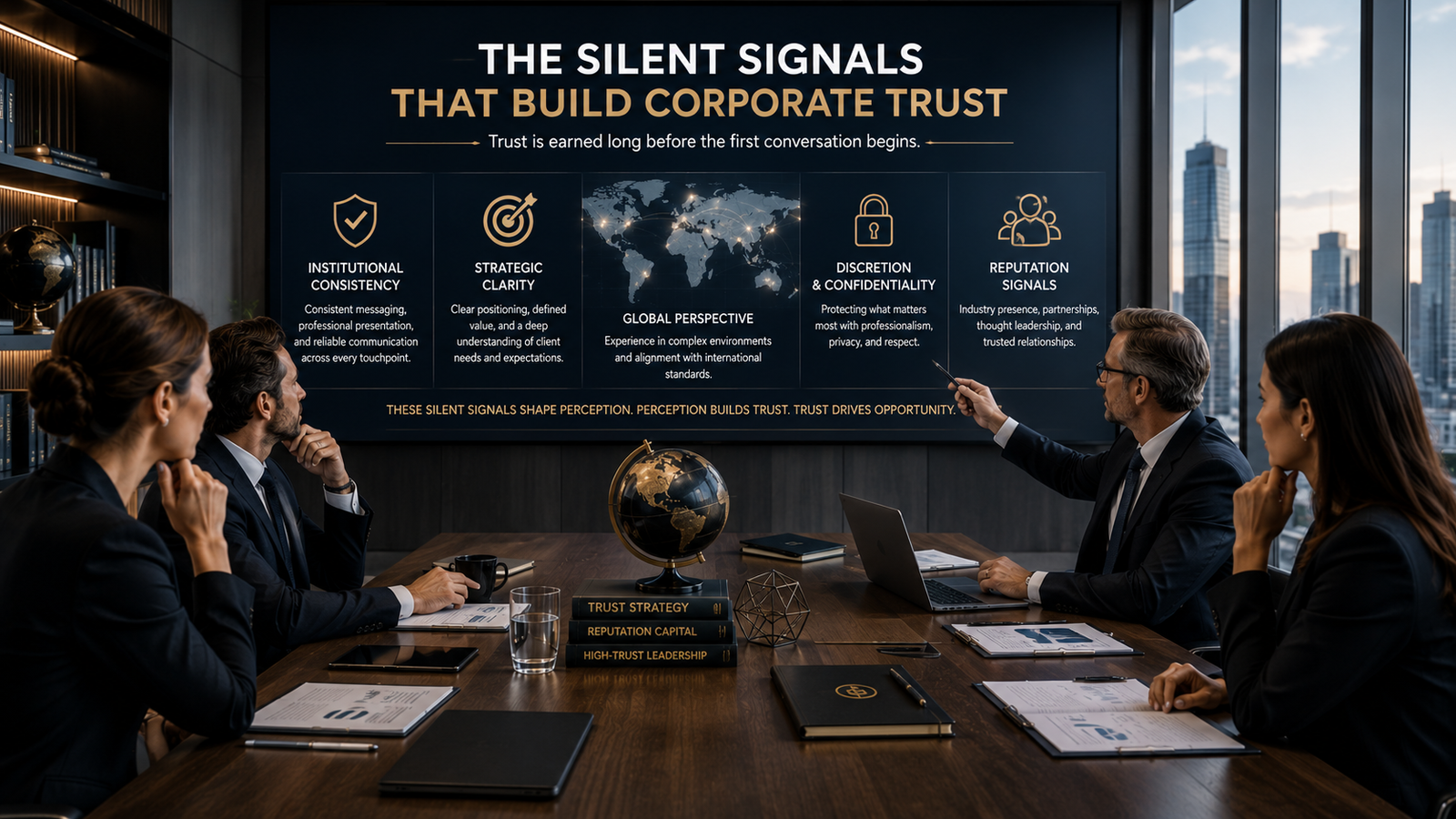


In many premium service industries, the most valuable aspects of a company are often the least visible.
Precision, coordination, discretion, and risk mitigation rarely appear in obvious ways. When executive transportation runs flawlessly, when security incidents are prevented, or when complex logistics unfold without disruption, the outcome looks simple.
From the outside, it may even look ordinary.
This creates a strategic challenge.
Companies operating in high-trust sectors frequently deliver immense value that is not immediately perceived by the market. And when value is not visible, it is often underestimated.
For organizations seeking to grow internationally, this gap between real value and perceived value becomes a critical barrier.
Understanding how to bridge that gap is essential for building authority, attracting corporate clients, and positioning effectively in global markets.
The Strategic Problem of Invisible Value
In industries such as executive transportation, private security, concierge services, and corporate support, value is rarely defined by what is seen.
It is defined by what is prevented, controlled, and managed.
- risks avoided
- delays eliminated
- disruptions prevented
- complexity absorbed.
These outcomes are inherently difficult to showcase.
Unlike tangible products or measurable outputs, invisible value does not present itself clearly in marketing materials or initial conversations.
As a result, companies often default to describing services in operational terms:
- fleet size
- coverage areas
- service features
- technical capabilities.
While these elements are important, they do not fully communicate the strategic role the company plays within a client’s operations.
This creates a disconnect.
The company understands its value deeply.
The market perceives only a fraction of it.
And in high-trust environments, perception directly influences opportunity.
How Corporate Clients Interpret Value
Corporate clients evaluating premium services do not always have the context needed to understand invisible value immediately.
Instead, they rely on signals that help them assess:
- reliability
- predictability
- institutional maturity
- alignment with corporate standards.
In many cases, decision-makers are not experts in the service itself.
An executive assistant coordinating travel, a procurement manager evaluating vendors, or a security director assessing partners must make decisions efficiently.
They do not analyze every operational detail.
They interpret value through clarity and confidence of communication.
If a company cannot clearly articulate its role and impact, the client may default to simpler evaluation criteria:
- price
- availability
- geographic presence
- familiarity.
This does not mean the client undervalues complexity.
It means the complexity has not been translated into recognizable value.
Companies that succeed in these environments are those that make the invisible visible — not by exposing operations, but by clarifying outcomes.
Why Many Companies Struggle to Communicate Their Real Value
The challenge of invisible value is not due to lack of capability.
It is due to how companies interpret their own expertise.
Several patterns contribute to this difficulty.