

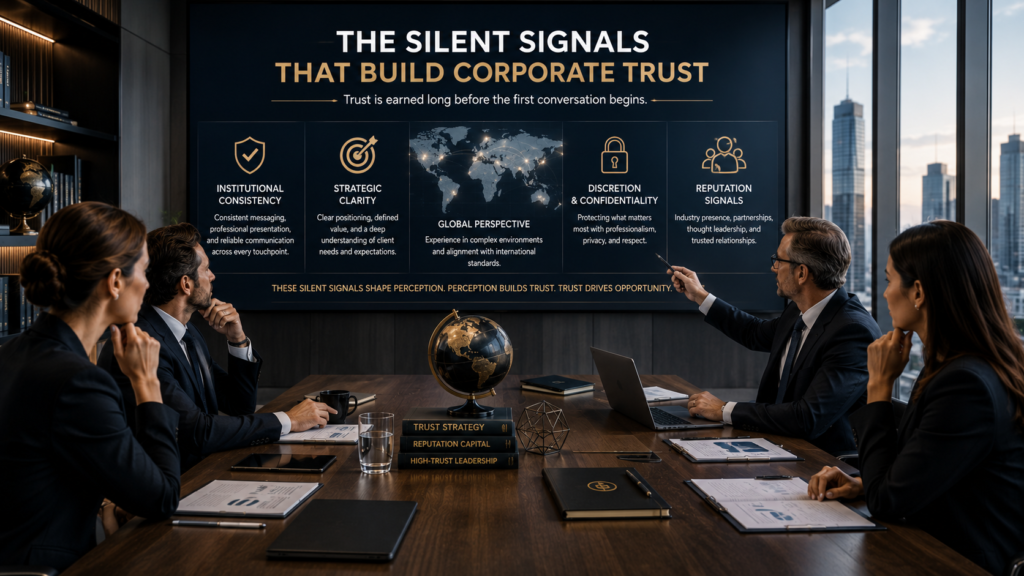
Corporate trust is rarely created by what a company says directly.
In premium B2B markets, trust is often shaped by quieter signals: how a company presents itself, how consistently it communicates, how clearly it defines its role, and how professionally it appears before any formal conversation begins.
This is especially true in high-trust service sectors such as executive transportation, private security, concierge services, corporate mobility, and global support networks. In these industries, clients are not only selecting a provider. They are selecting an organization that may influence executive safety, reputation, operational continuity, and client experience.
The challenge is that many companies focus on visible claims of trust while neglecting the subtle indicators that actually shape perception.
Understanding these silent signals reveals why some companies appear credible immediately — while others must work much harder to be trusted.
Trust Is Built Before It Is Requested
In premium service industries, trust is not created at the moment a company asks for it.
It is built gradually through repeated signals that reduce uncertainty.
Corporate clients rarely begin by believing every claim a provider makes. They observe, compare, interpret, and evaluate. They look for evidence that the company is stable, disciplined, and aligned with the expectations of high-value business environments.
This process often happens quietly.
A procurement team may review a company’s website before making contact. A security director may assess whether the company appears mature enough to support sensitive operations. An executive office may look for signs of discretion, professionalism, and consistency.
These early impressions matter.
A company that communicates with clarity and structure sends a message of control. A company that appears inconsistent or generic may create hesitation, even if its operational capabilities are strong.
This is why corporate trust is not only an operational achievement.
It is a positioning outcome.
The market must be able to see enough credible signals to believe that the company can be trusted before the relationship begins.
How Corporate Clients Interpret Trust in High-Stakes Markets
Corporate clients do not evaluate trust emotionally. They evaluate it through risk.
In sectors such as executive transportation, private security, luxury concierge, and international support services, the consequences of choosing the wrong provider can be significant.
A transportation failure may affect executive schedules. A security failure may expose people or assets. A concierge failure may damage the experience of a high-value client. A coordination failure may create embarrassment for the organization behind the request.
Because of this, trust is closely connected to predictability.
Clients want to know whether a company can perform consistently under pressure. They want to understand whether the company communicates clearly, operates discreetly, and respects corporate standards.
Trust is therefore assessed through signals such as:
- institutional maturity
- consistency of communication
- visible professionalism
- reputation within relevant networks
- clarity of positioning
- alignment with premium expectations.
These indicators help decision-makers reduce uncertainty.
In many cases, the client does not need to know every operational detail at the beginning. They need to feel that the company is credible enough to enter serious evaluation.
That initial confidence is built through silent signals.
Why Many Companies Misunderstand Trust
Many companies believe trust is built mainly through direct experience.
They assume that once a client uses the service, the quality of delivery will prove everything.
This is partly true.
Long-term trust depends on performance.
However, the first barrier is not delivery. It is consideration.
Before a company can prove itself operationally, it must first be perceived as credible enough to be chosen.
This is where many capable companies struggle.
They may have excellent teams, strong local reputation, loyal clients, and years of experience. But if their external presence does not communicate authority, they may still appear unremarkable to new corporate buyers.
Another common mistake is relying on generic trust language.
Words such as “reliable,” “professional,” “trusted,” and “high-quality” are common across premium service markets. These words may be true, but they rarely differentiate a company.
Trust is not created by claiming trustworthiness.
It is created by demonstrating signals that make trust feel reasonable.
A company does not become credible because it says it is credible. It becomes credible when every visible detail supports that conclusion.
Three Silent Signals That Build Corporate Trust
1. Institutional Consistency
Corporate clients trust companies that appear stable and structured.
Institutional consistency means the company communicates with the same level of professionalism across every touchpoint:
website, proposals, presentations, emails, leadership communication, service descriptions, and public content.
When these elements align, the company appears controlled and mature.
When they are fragmented, the company may appear less reliable.
In high-trust industries, inconsistency creates friction. It forces the client to work harder to understand the company.
And when decision-makers must work too hard to evaluate a provider, uncertainty increases.
Institutional consistency signals that the company knows who it is, what it represents, and how it operates.
That clarity builds confidence.
2. Strategic Clarity
Trust grows when a company is easy to understand.
This does not mean oversimplifying complex services. It means explaining the company’s value in language that corporate clients can quickly interpret.
For example, an executive transportation company should not only describe vehicles and chauffeurs. It should communicate how it supports executive mobility, discretion, punctuality, and operational continuity.
A private security company should not only describe personnel and protection. It should communicate risk awareness, prevention, judgment, and reputation protection.
A concierge service should not only describe requests and access. It should communicate time protection, complexity reduction, and premium client experience.
Strategic clarity helps clients understand why the service matters.
When the role of the company is clear, trust becomes easier to form.
3. Visible Reputation Signals
Corporate trust is strengthened when a company appears connected to the right ecosystem.
This does not require constant promotion.
In premium markets, quiet visibility is often more powerful than aggressive exposure.
Reputation signals may include:
- presence in relevant industry conversations
- strategic articles and insights
- participation in professional networks
- partnerships with credible organizations
- consistent leadership perspective
- evidence of experience in high-trust environments.
These signals show that the company is not operating in isolation.
It belongs to a professional environment where credibility matters.
For corporate clients, this reduces perceived risk.
A company that is visible in the right contexts feels more familiar. Familiarity makes evaluation easier. Easier evaluation accelerates trust.
Conclusion
Corporate trust is rarely built through one dramatic statement or one impressive presentation.
It is built through silent signals that accumulate over time.
In premium B2B service markets, clients look for evidence of maturity, clarity, consistency, and credibility long before they make a decision.
Companies that understand this dynamic treat positioning as part of trust-building.
They know that every visible detail contributes to perception.
The way a company presents itself, explains its value, appears in its industry, and communicates its role all influence whether corporate clients feel confident enough to engage.
In high-trust markets, trust is not only earned through performance.
It is signaled before performance can even be experienced.
Companies operating in high-trust international markets often discover that growth depends on positioning as much as operations.
If your company is navigating this challenge, applying for a strategic diagnosis can be a valuable first step.