

Some of the most valuable services in premium B2B markets are difficult to see, measure, or explain at first glance.
Executive transportation, private security, concierge services, corporate mobility, and international support operations often create value by preventing problems rather than producing visible outcomes. When the service works perfectly, there is no disruption, no delay, no incident, and no visible complexity.
That is precisely the challenge.
The better the service performs, the less obvious its value may appear to the client or the market.
For companies operating in high-trust service industries, this creates a strategic communication problem. If the value is invisible, it can easily be underestimated, compared on price, or misunderstood as a basic operational function.
Understanding how to communicate invisible value is therefore essential for companies that want to build authority, strengthen credibility, and compete for premium corporate clients.
Invisible Value Requires Strategic Translation
In premium service industries, value often exists beneath the surface.
A private security company may prevent risk through planning, intelligence, coordination, and judgment. An executive transportation company may create value through timing, discretion, route planning, and executive experience. A concierge service may protect a client’s time, reduce friction, and solve complex requests quietly.
Yet from the outside, these outcomes may appear simple.
A client arrives on time.
A trip runs smoothly.
A sensitive situation never escalates.
A complex request is handled without drama.
The visible result is calm. The invisible work is what created it.
This means companies cannot rely only on service descriptions to explain their value. Listing features, assets, or operational capabilities rarely communicates the full strategic importance of the service.
The real task is translation.
The company must translate invisible operational complexity into language that decision-makers understand: risk reduction, continuity, confidence, discretion, and predictability.
This translation does not simplify the service itself. It clarifies its role.
In high-trust markets, the companies that communicate best are not the ones that explain every operational detail. They are the ones that make the strategic consequence of their work unmistakably clear.
How Corporate Clients Evaluate Invisible Services
Corporate clients do not evaluate invisible services in the same way they evaluate visible products.
They cannot always inspect the full value before buying. They cannot easily compare every operational detail. And in many cases, they only understand the true importance of the service when something goes wrong.
Because of this, decision-making is shaped by risk evaluation.
A multinational company choosing an executive transportation provider is not only asking whether the company has vehicles and chauffeurs. It is asking whether executives will move safely, punctually, and discreetly across unfamiliar environments.
A corporate client selecting a private security partner is not only assessing personnel. It is evaluating judgment, discipline, confidentiality, and the ability to prevent exposure.
A concierge or international support provider is not only judged by responsiveness. It is evaluated by how well it protects time, manages complexity, and preserves the client’s standard of experience.
In these markets, clients look for signals that reduce uncertainty.
They assess:
- whether the company appears institutionally mature
- whether communication is clear and disciplined
- whether the company understands corporate expectations
- whether reputation supports trust
- whether the service is framed as strategic, not merely functional.
This is why invisible services require stronger positioning than visible services.
When the value cannot be immediately seen, the company’s credibility must carry more weight.
Why Many Companies Fail to Communicate Invisible Value
Many companies in premium service sectors struggle not because their value is weak, but because their value is hidden inside operations.
They know what happens behind the scenes. They understand the planning, pressure, coordination, and judgment required. Their clients often appreciate the service once they experience it.
But new prospects do not have that context.
This creates a gap between internal value and external perception.
One common mistake is describing the service too literally.
An executive transportation company may say it provides “chauffeur services.” A security company may describe “protection services.” A concierge provider may present “personal assistance.”
These descriptions are accurate, but strategically limited.
They describe the function, not the value.
Another issue is over-explaining operational detail. Companies sometimes believe that showing complexity proves expertise. In reality, too much technical detail can make the service harder to understand and harder to value.
Corporate decision-makers are not always looking for operational depth at the first stage. They are looking for confidence.
They want to know what risk is reduced, what outcome is protected, and why this company is a safer choice than another.
The deeper problem is that many companies communicate from their own perspective rather than from the client’s risk environment.
They explain what they do.
But they do not clearly explain what their work protects, enables, or prevents.
That is where invisible value becomes strategically visible.
Three Strategic Signals That Make Invisible Value Clear
1. Translate Service Features Into Business Outcomes
The first step is to move from operational language to outcome language.
A service feature explains what the company does. A business outcome explains why it matters.
For example:
- “24/7 availability” becomes continuous operational support for time-sensitive executive needs.
- “Experienced chauffeurs” becomes predictable executive mobility in complex environments.
- “Security personnel” becomes reduced exposure for people, assets, and reputation.
- “Concierge support” becomes frictionless coordination for high-value clients and executives.
This shift changes the client’s perception.
The company is no longer presenting itself as a vendor performing tasks. It is positioning itself as a partner protecting continuity, confidence, and control.
In premium B2B markets, this distinction matters.
Clients may compare vendors on service features. But they choose partners based on the outcomes they trust them to protect.
2. Frame the Service as Risk Reduction
Invisible services become easier to understand when they are connected to risk.
Most premium service companies operate inside environments where failure has consequences. A delay, a security lapse, a poorly managed arrival, or a mishandled executive request can affect more than convenience.
It can affect reputation, safety, continuity, and trust.
That is why companies should frame their value around the risks they reduce.
For example, executive transportation is not only about movement. It is about reducing uncertainty around timing, discretion, comfort, and executive experience.
Private security is not only about presence. It is about prevention, judgment, and controlled exposure.
Concierge services are not only about access. They are about protecting time, simplifying complexity, and maintaining standards under pressure.
When companies communicate through this lens, clients understand the strategic weight of the service more quickly.
Risk reduction gives invisible value a visible structure.
3. Build Credibility Before Explanation
When value is invisible, credibility must arrive before explanation.
Corporate clients are more likely to understand a complex service when they already perceive the company as credible. Without credibility, even strong explanations may be treated cautiously.
This is why reputation, positioning, and professional presence matter so much.
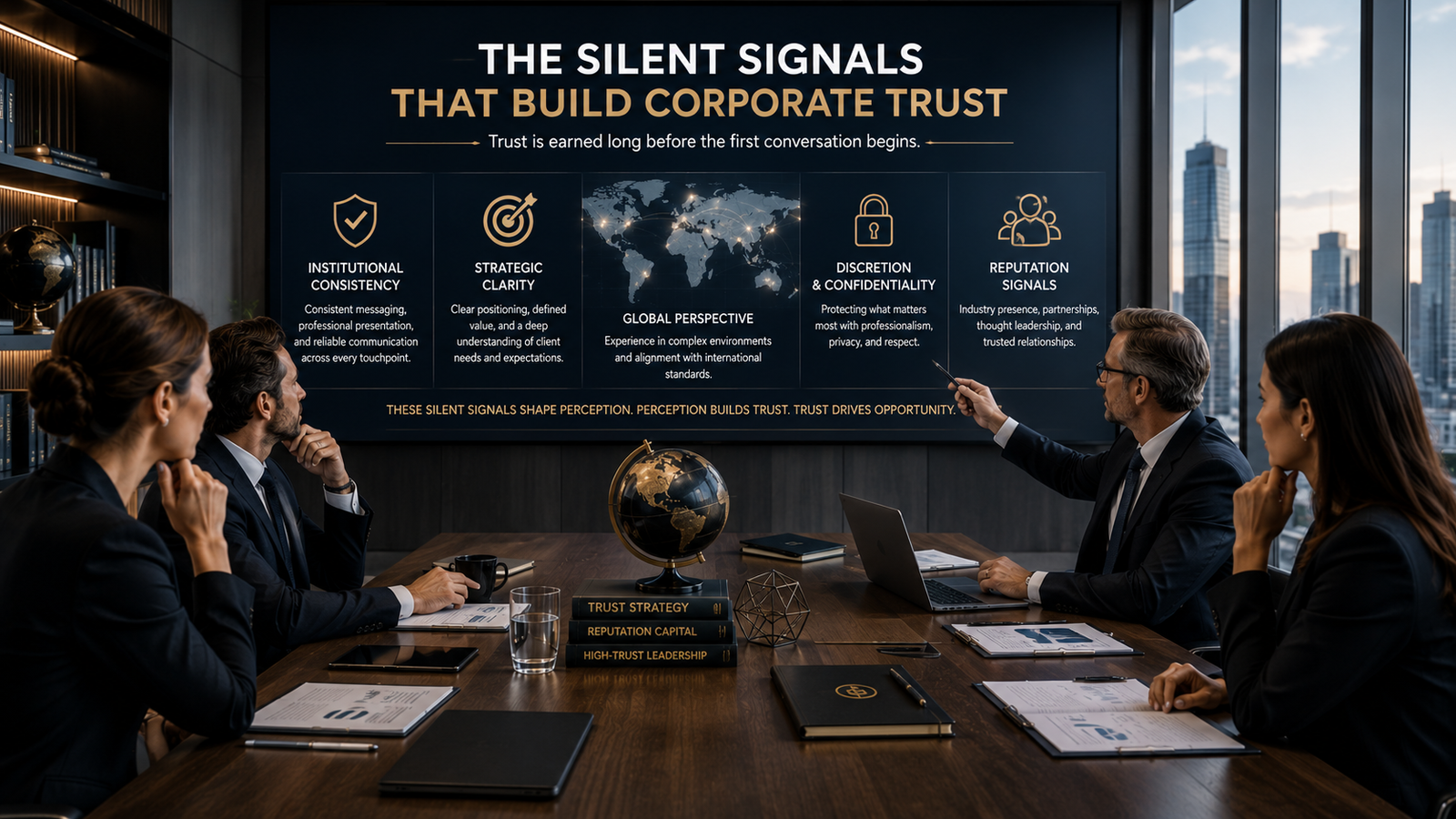
Credibility is shaped by signals such as:
- clear strategic messaging
- consistent visual and verbal identity
- professional documentation
- visible industry perspective
- strong corporate tone
- evidence of experience in high-trust environments.
These signals help the client feel that the company understands the standards of premium corporate markets.
In many cases, clients decide whether a company is worth serious consideration before they fully understand every detail of the service.
A credible company earns the right to explain.
An unclear company must first overcome skepticism.
For invisible services, that difference can determine whether the conversation happens at all.
Conclusion
Invisible services are often among the most important services in premium B2B markets.
They protect time, reduce risk, prevent disruption, and create confidence in environments where failure can carry serious consequences.
But invisible value does not communicate itself.
Companies must translate operational complexity into strategic meaning. They must move beyond service descriptions and clarify the outcomes they protect. They must show how their work reduces risk, supports continuity, and strengthens trust.
In high-trust international markets, the companies that win are not always the ones with the most complex operations.
They are the ones that make their value easiest to understand.
When invisible value becomes strategically clear, the company becomes easier to trust, easier to recommend, and easier to choose.
Companies operating in high-trust international markets often discover that growth depends on positioning as much as operations.
If your company is navigating this challenge, applying for a strategic diagnosis can be a valuable first step.