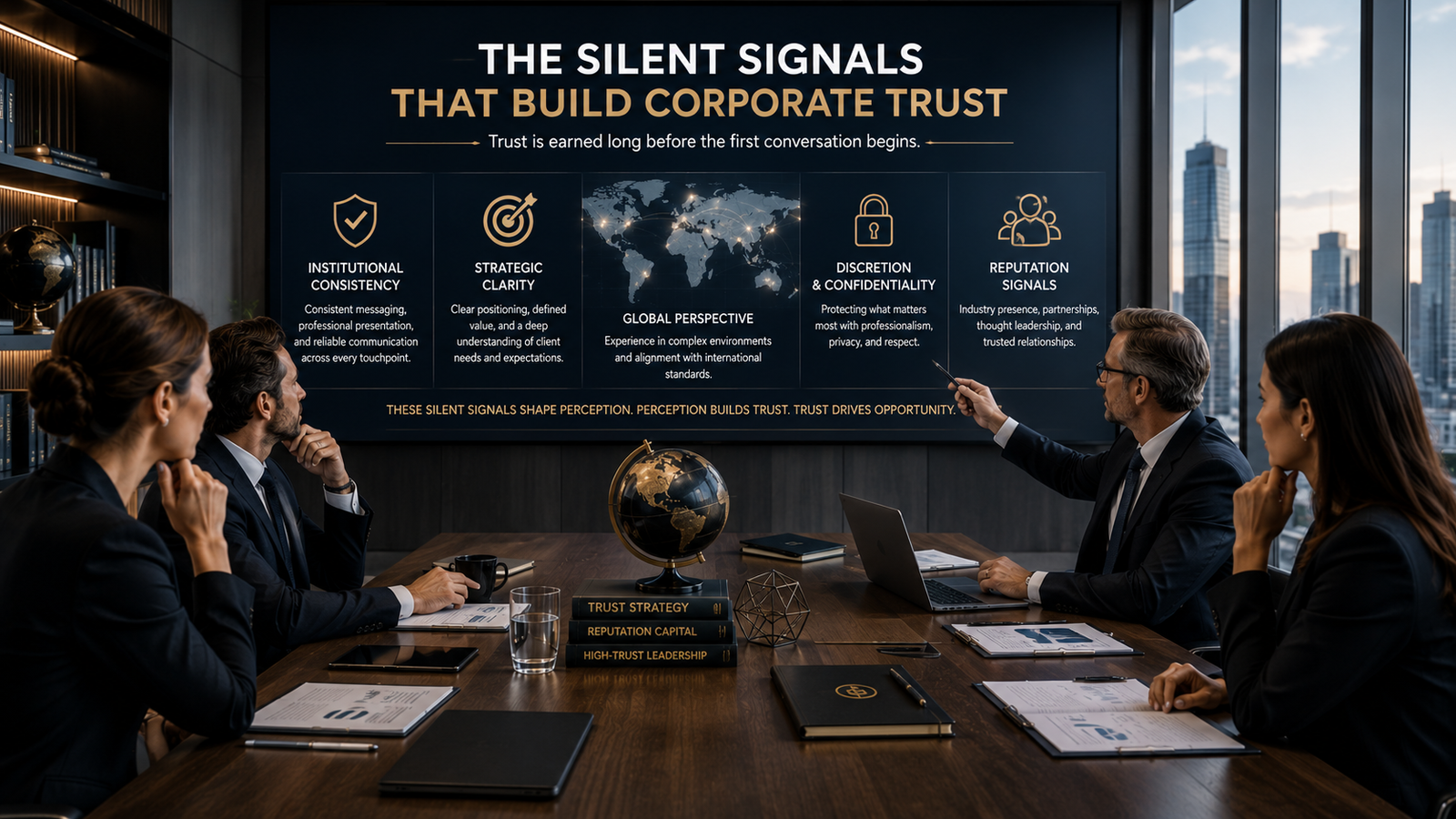


Global partnerships are rarely created by opportunity alone. They are created by recognition, trust, and strategic alignment long before formal conversations begin.
In premium service industries, many companies believe that international partnerships depend mainly on operational capacity, geographic coverage, or commercial ambition. These elements matter, but they are not enough.
Organizations operating in executive transportation, private security, concierge services, corporate mobility, and high-trust global support are evaluated through a different lens. Potential partners are not only asking whether a company can deliver. They are asking whether the company is credible enough to represent them, support their clients, and operate within sensitive international environments.
This is where positioning becomes decisive.
To build global partnerships, a company must be seen not merely as a service provider, but as a reliable strategic counterpart within the international service ecosystem.
Global Partnerships Begin With Strategic Perception
A global partnership is not simply a commercial agreement between two companies.
In high-trust service industries, it is a transfer of confidence.
When an international company refers clients, coordinates operations, or integrates another provider into its network, it is extending part of its own reputation to that partner.
This makes the decision highly sensitive.
A global mobility company, for example, cannot risk working with a local transportation provider that appears unstructured. A security network cannot rely on a regional partner whose communication lacks consistency. A concierge group cannot recommend a service provider that does not reflect the expectations of premium corporate clients.
The issue is not only performance.
It is perception.
Before a partnership begins, the potential partner must feel confident that the company is stable, professional, discreet, and aligned with international standards.
This confidence is shaped by positioning.
A company that presents itself only as a local operator may be respected in its home market, but still appear limited in the eyes of international partners. A company that communicates with institutional clarity, global awareness, and strategic consistency becomes easier to evaluate and easier to trust.
This is why positioning is not a cosmetic exercise.
It is the foundation that allows external organizations to understand where the company fits within the global market.
How Global Partners Actually Evaluate Companies
Companies seeking international partnerships often focus on what they want to say about themselves.
But global partners evaluate from a different perspective.
They are asking:
- Can this company protect our reputation?
- Can it operate consistently under pressure?
- Does it understand international expectations?
- Will communication be clear, fast, and professional?
- Can we trust this company with high-value clients?
These questions are especially important in premium service industries because the end client often has high expectations and low tolerance for failure.
A corporate client requiring executive transportation in a foreign market is not only looking for a vehicle. They expect punctuality, discretion, safety, professional conduct, and seamless coordination.
A company requesting security support is not only buying manpower. It is relying on judgment, discipline, risk awareness, and confidentiality.
A concierge partner is not only outsourcing tasks. It is depending on cultural sensitivity, responsiveness, and polished execution.
In each case, the potential partner evaluates both operational capability and reputational fit.
This evaluation often begins before direct contact.
A company’s website, leadership presence, public content, case framing, communication style, and industry visibility all influence perception.
If these signals are weak or inconsistent, the company may be overlooked before its capabilities are fully understood.
Global partnerships are rarely formed with companies that are difficult to interpret.
They are formed with companies that appear credible, clear, and aligned.
Why Many Strong Companies Fail to Attract Global Partnerships
Many capable companies struggle to build global partnerships because they mistake operational strength for strategic readiness.
They may have excellent teams, loyal clients, strong local reputation, and years of experience. Yet they still fail to appear partnership-ready to international organizations.
There are several reasons for this.
First, many companies communicate from a local perspective.
They emphasize local leadership, local experience, or regional recognition. These signals may be powerful inside the home market, but they do not always translate globally.
International partners may not understand the importance of a local award, a regional client base, or a domestic reputation.
Second, many companies describe services instead of defining their strategic role.
They say what they do, but not why they matter in a global context.
For example, “executive transportation services” is a service description. “Corporate mobility support for high-value international clients” communicates a broader role.
The second statement helps potential partners understand where the company fits.
Third, many companies lack narrative consistency.
Their website says one thing. Their sales materials say another. Their leadership communication is absent or disconnected. Their service descriptions are generic.
This inconsistency creates uncertainty.
And uncertainty slows partnership decisions.
In global service markets, companies do not need to appear larger than they are. But they do need to appear structured, reliable, and strategically clear.
Three Strategic Signals That Attract Global Partnerships
Global partnerships are built through trust, but trust is shaped by signals.
Companies that become attractive to international partners usually demonstrate three strategic qualities.
1. Institutional Credibility
Potential partners look for companies that appear stable and professionally managed.
Institutional credibility is visible through:
- clear corporate positioning
- consistent communication
- professional presentation
- defined leadership perspective
- structured service language.
This does not mean a company must look like a multinational corporation.
It means the company must appear mature enough to handle responsibility on behalf of another organization.
A partner wants to know that if a client is referred, the experience will be handled with discipline and care.
Institutional credibility reduces perceived risk.
It tells the market that the company is not improvised, informal, or dependent only on personal relationships.
In premium service industries, this signal is essential.
2. Global Relevance
A company seeking global partnerships must communicate relevance beyond its local market.
This does not require exaggerating international reach.
It requires framing the company’s value in terms that global partners understand.
For example:
- not only “chauffeur service,” but executive mobility coordination
- not only “security personnel,” but risk-aware protection support
- not only “concierge service,” but high-trust lifestyle and corporate support
- not only “local provider,” but reliable partner for international clients entering the market.
Global relevance comes from showing that the company understands the expectations, pressures, and standards of international clients.
Partners are not simply looking for availability.
They are looking for alignment.
A company that communicates global relevance becomes easier to integrate into international networks.
3. Reputation Visibility
Global partnerships often emerge from familiarity.
A company that is consistently visible within its sector becomes easier to remember, easier to evaluate, and easier to trust.
This visibility may come from:
- strategic articles
- industry commentary
- participation in professional networks
- partnerships with related service providers
- consistent presence in relevant business conversations.
Visibility does not need to be loud.
In premium markets, quiet authority is often more effective than aggressive promotion.
The objective is not to appear everywhere.
The objective is to appear in the right contexts with a clear and credible point of view.
When potential partners repeatedly encounter a company’s name, positioning, and perspective, familiarity begins to form.
Over time, familiarity supports trust.
And trust opens the door to partnership.
Conclusion
Global partnerships are not built only through outreach, networking, or commercial ambition.
They are built through strategic perception.
In premium service industries, companies are evaluated by how clearly they communicate credibility, maturity, and relevance within international environments.
Operational capability is essential, but it must be visible through the right signals.
A company that wants to attract global partners must move beyond describing its services. It must define its role in the broader ecosystem, communicate with institutional clarity, and build a reputation that can travel across borders.
The companies that succeed globally are not always the largest.
They are often the ones that are easiest to trust.
And trust begins with positioning.
Companies operating in high-trust international markets often discover that growth depends on positioning as much as operations.
If your company is navigating this challenge, applying for a strategic diagnosis can be a valuable first step.